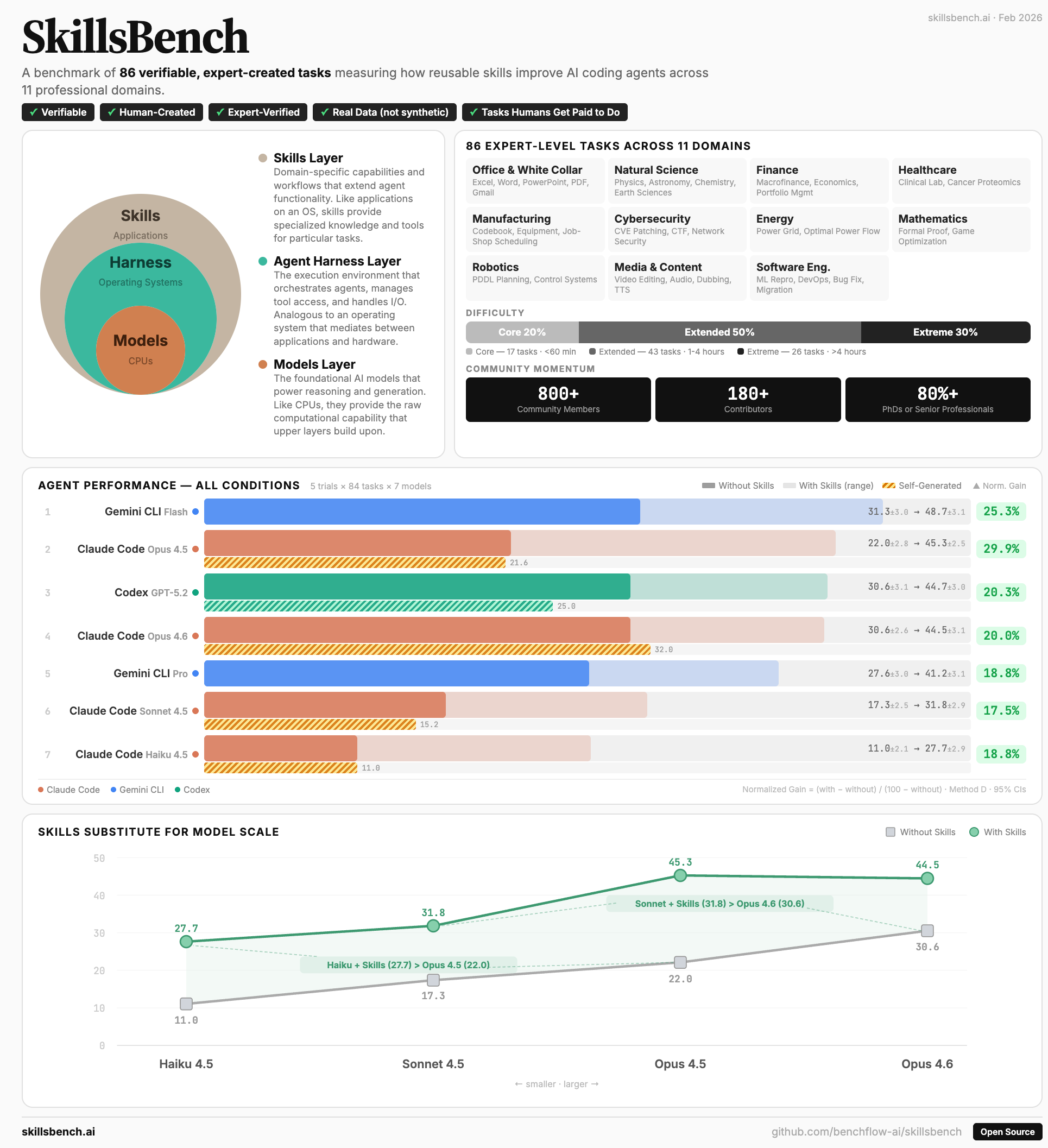
SkillsBench separates three parts of an agent system: the foundation model, the harness, and reusable procedural skills. Paired evaluations with and without skills measure their actual contribution to task completion.
Real tasks: expert-curated workflows spanning software, science, office work, finance, and other professional domains.
Controlled evaluation: deterministic verifiers and comparisons with curated, self-generated, and no-skill conditions.
Open ecosystem: task environments, reusable skills, evaluation tools, and a public agent leaderboard.
The benchmark is used in frontier-model evaluations, with references from Meta, Tencent, Qwen, and GitHub.
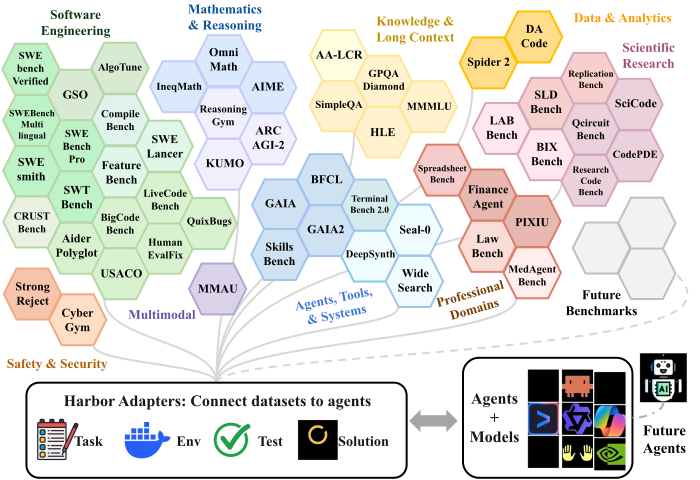
Harbor Adapters translates heterogeneous benchmarks into a shared format so agents can be evaluated through a consistent execution pipeline. Harbor-Index turns that breadth into a curated meta-dataset for efficient comparison.
Scale: large-scale evaluation across 54 adapted benchmarks, using 226B tokens and over $300K in compute.
Curation: 82 tasks from 29 benchmarks, selected from 6,627 candidates and checked for verifier alignment, clear success criteria, and environment reliability.
Coverage: software engineering, scientific reasoning, search, data analysis, cybersecurity, and long-horizon tool use.
Built on the Harbor framework ★ 6.8k+, with open adapters and reproducible evaluation workflows.
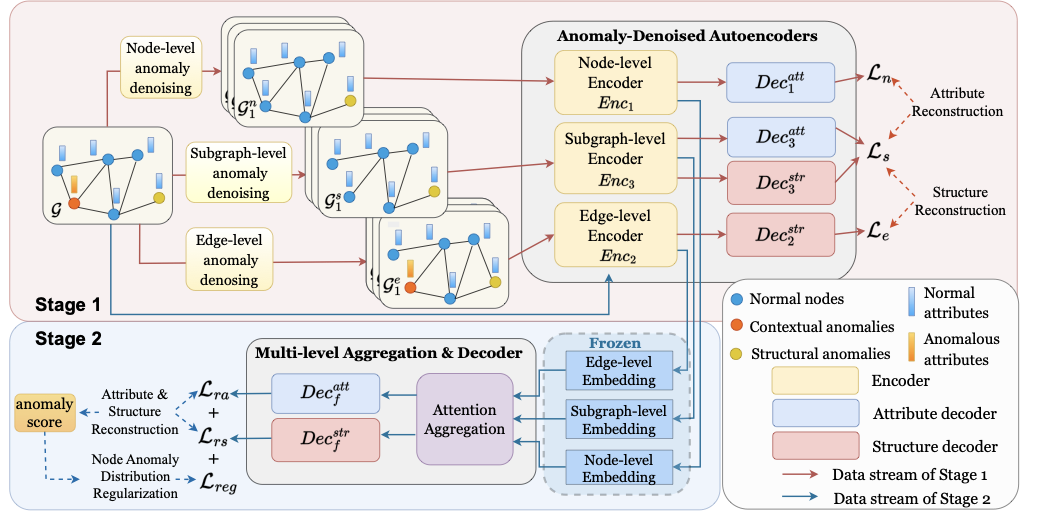
The official PyTorch implementation of our two-stage graph anomaly detection framework. Anomaly-denoised graph augmentations support multi-level pretraining; decoders are then retrained on the original graph for detection.
The repository includes model code, dataset handling, configuration files, and scripts for running the experiments.