评测
评测方法始终在不断演进。 理解大语言模型的评测(尤其是后训练阶段),关键在于:当前流行的评测体系其实反映了主流训练实践和目标的变迁。 虽然有挑战性的评测推动了模型能力的突破,但大多数评测的设计初衷还是为新模型提供有用的信号。
本章将以小故事的方式,梳理RLHF早期历史中流行的评测体系,帮助读者理解其中的共性、细节与常见失效模式。
RLHF与后训练的评测经历了几个明显阶段:
- 早期聊天阶段:最早的RLHF或偏好微调模型,评测重点是模型的对话表现,尤其是与GPT-4等强模型的比较。典型评测有MT-Bench [1]、AlpacaEval [2]、Arena-Hard [3]。这些评测领域现在被归类为“聊天”或“指令跟随”。
- 多技能时代:随着时间推移,业界逐渐认识到RLHF不仅能提升聊天能力,还能改善多种技能。例如,Tülu评测套件涵盖知识(MMLU [4]、PopQA [5]、TruthfulQA [6])、推理(BigBenchHard [7]、DROP [8])、数学(MATH [9]、GSM8K [10])、代码(HumanEval [11]、HumanEval+ [12])、指令跟随 [13]、安全性(多项评测综合)。这反映了后训练已被视为多面手,而不仅仅是安全或聊天的解决方案。
- 推理与工具阶段:当前后训练的主流方向是挑战性更高的推理与工具使用任务,包括知识密集型难题(如GPQA Diamond [14]、Humanity’s Last Exam [15])、复杂软件工程任务(如SWE-Bench+ [16]、LiveCodeBench [17]),以及高难度数学题(如最近的AIME竞赛题)。
未来还会有更多新领域不断涌现。 随着AI产业化,评测的激励机制也在变化,变得多方参与、多元化。 自ChatGPT发布以来,私有评测如Scale Leaderboard [18]、社区驱动评测如ChatBotArena [19],以及第三方评测公司如ArtificialAnalysis、Epoch AI等大量涌现。 本章会结合这些评测的实际落地细节进行讲解。
提示格式化:从Few-shot到Zero-shot再到CoT
Prompting(提示工程)本质上是一个动词,但也被认为是一门可以专门练习和训练的“手艺”[20]。 Prompt是为语言模型组织信息和上下文的方式。 日常交互中的prompt通常很简单,但在高级场景下,精心设计的prompt往往决定了模型能否成功完成任务。
在评测中,prompt设计对模型表现影响巨大。 有些提示格式(见下文)甚至能让模型表现从60%跌到接近0。 同样,prompt的变化也能帮助模型在训练中学得更好。 业界常说,“会写prompt”能让你提前体验“未来”模型的能力,突破常规用法的天花板。
现代大模型的高阶prompt往往是一份完整的报告(动辄上千token)。 这种行为改变了模型性能的评测和理解方式。
早期语言模型只被当作智能补全工具。 若想让模型更灵活地完成任务,通常会给出多个示例,再加一个待补全的prompt,这就是few-shot或in-context learning [21],当时还没有指令微调或RLHF。 例如:
# Few-Shot Prompt for a Question-Answering Task
You are a helpful assistant. Below are example interactions to guide your style:

### Example 1
User: "What is the capital of France?"
Assistant: "The capital of France is Paris."

### Example 2
User: "Who wrote the novel '1984'?"
Assistant: "George Orwell wrote '1984.'"

# Now continue the conversation using the same style.
User: "Can you explain what a neural network is?"
Assistant:
对于MMLU风格的多选题,也可以这样few-shot:
# Few-Shot Prompt

Below are examples of MMLU-style questions and answers:

### Example 1
Q: A right triangle has legs of lengths 3 and 4. What is the length of its hypotenuse?
Choices:
(A) 5
(B) 6
(C) 7
(D) 8

Correct Answer: (A)

### Example 2
Q: Which of the following is the chemical symbol for Sodium?
Choices:
(A) Na
(B) S
(C) N
(D) Ca

Correct Answer: (A)

### Now answer the new question in the same style:

Q: Which theorem states that if a function f is continuous on a closed interval [a,b], then f must attain both a maximum and a minimum on that interval?
Choices:
(A) The Mean Value Theorem
(B) The Intermediate Value Theorem
(C) The Extreme Value Theorem
(D) Rolle’s Theorem

Correct Answer:这里可以直接采样生成答案(A/B/C/D),也可以计算各选项的概率,看正确答案是否概率最大(如[22]所述)。 概率法既可以用选项字母,也可以用完整答案文本,两种都合理,但实际评测更常用选项概率。
few-shot提示的常见问题是模型不遵守格式,导致答案判错。 设计评测时,in-context示例数量也是参数,通常3到8个甚至更多。
few-shot提示发展过程中,出现了链式思维(chain-of-thought, CoT)示例,即示例中包含详细推理过程(后来发展为明确提示模型“逐步思考” [23]):
# standard prompting
Q: Roger has 5 tennis balls. He buys 2 more cans of tennis balls. Each can has 3 tennis balls. How many tennis balls does he have now?

A: The answer is 11.

Q: The cafeteria had 23 apples. If they used 20 to make lunch and bought 6 more, how many apples do they have?

A: The answer is ...

# chain of thought prompting
Q: Roger has 5 tennis balls. He buys 2 more cans of tennis balls. Each can has 3 tennis balls. How many tennis balls does he have now?

A: Roger started with 5 balls. 2 cans of 3 tennis balls each is 6 tennis balls. 5 + 6 = 11. The answer is 11.

Q: The cafeteria had 23 apples. If they used 20 to make lunch and bought 6 more, how many apples do they have?

A: The cafeteria had 23 apples originally. They..
随着模型能力提升,zero-shot评测(零样本学习)成为主流 [24]。 FLAN(Finetuned Language Net)证明了指令微调后的模型能泛化到未见过的zero-shot问题 [24](T0 [25]也有类似结果)。 这也推动了指令微调(IFT)的流行,为RLHF和后训练奠定了基础。 zero-shot问题示例如下:
User: "What is the capital of France?"
Assistant:
自2022年起,早期RLHF代表作如InstructGPT等陆续出现。 这些模型的核心能力和用例,转向更开放的生成式场景。 随着开放性增强,生成式评测愈发流行,因为这更贴近真实应用。 在ChatGPT发布后的几年里,RLHF研究仍保留多选评测作为对比。
到2024年底、2025年初,推理模型兴起,模型行为发生重大变化——每个答案前都会输出长链式思维(CoT)推理过程。 这时,模型不再需要经典的“think step by step”提示(见[26])。
比如,为了让模型在多选题上输出CoT,可用如下特殊prompt(Tülu 3 [27]):
Answer the following multiple-choice question by giving the correct answer letter in parentheses. Provide CONCISE reasoning for the answer, and make sure to finish the response with “Therefore, the answer is (ANSWER_LETTER)” where (ANSWER_LETTER) is one of (A), (B), (C), (D), (E), etc.

Question: {question}
(A) {choice_A}
(B) {choice_B}
(C) …

Answer the above question and REMEMBER to finish your response with the exact phrase “Therefore, the answer is (ANSWER_LETTER)” where (ANSWER_LETTER) is one of (A), (B), (C), (D), (E), etc.
尤其当模型用特殊格式分隔思考token和答案token时,评测体系也随之更新。 如今,评测正转向链式思维生成的开放式测试。
评测的使用与观察
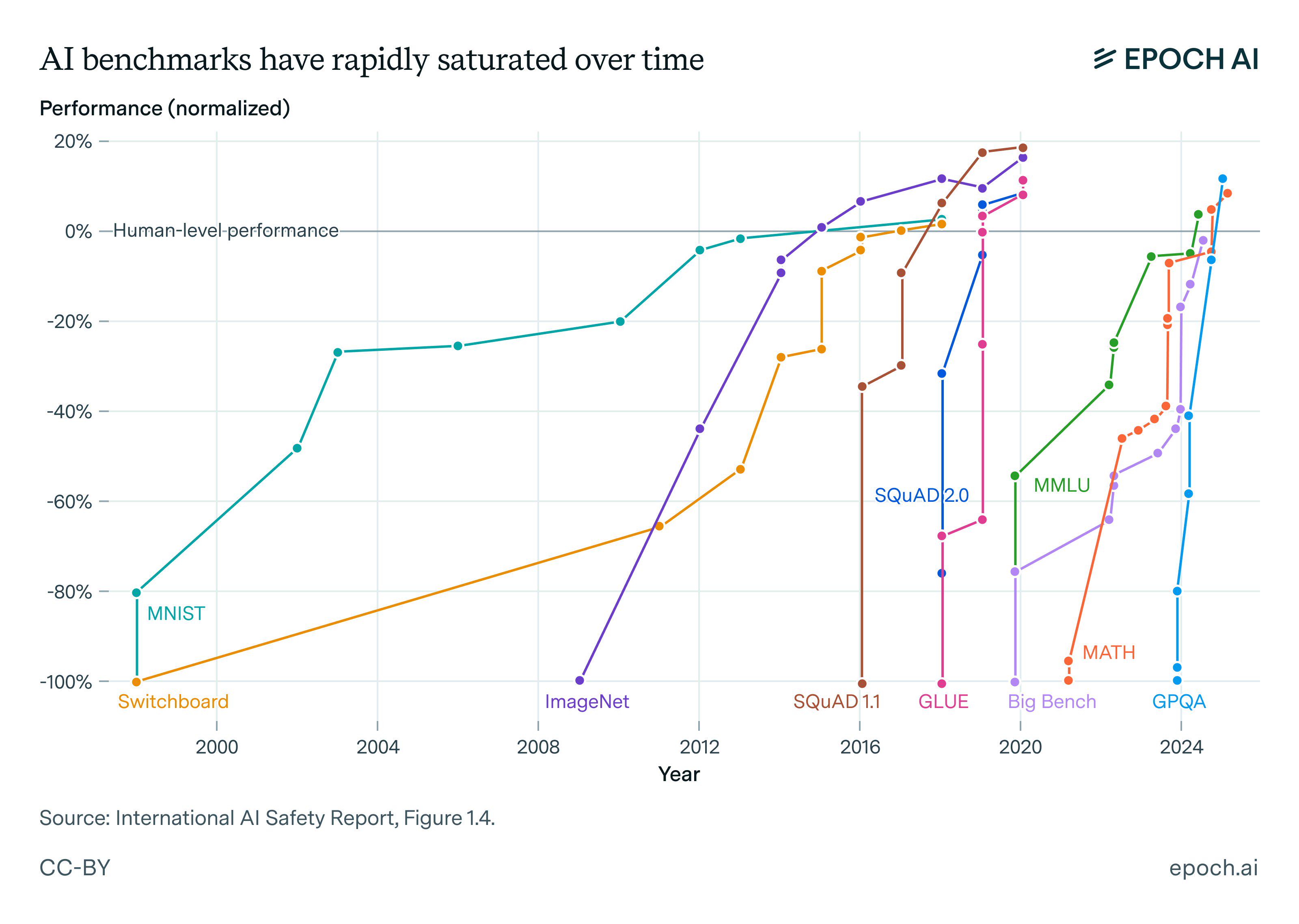
公司内部的大模型评测只能与同行横向对比(且误差很大),因为内部评测流程与外部评测不一致。 反复用于调参的内部评测实际上承担验证集的角色;仍应另设未用于调参的测试集。 而社区用来比较领先模型的公开评测,无法确定是否被作为训练集、测试集或验证集。
随着评测分数成为企业营销的核心,评测流程在公司内部不断变化。 据说一些大厂会为GSM8k、MATH等重要评测设计“定制prompt”。 这些做法变化极快。
大模型评测体系常被视为营销手段,因为评测没有标准的“真理源”。 前沿实验室会根据自身需求调整评测套件。 公开的分数只是实验室模型的输出结果,输入细节并未全部披露。 这些输入细节极为敏感,不同公司(OpenAI、Meta、Anthropic、Google)各不相同。 即便是完全开源的评测标准,也很难保证可复现性。 固定模型版本、提示模板、采样参数、推理预算与评分代码,有助于提升可重复性;跨团队比较也需要披露这些条件。 当然,技术团队的出发点是好的。
如今,前沿大模型的评测既是科学,也是艺术。
不同团队会选择不同评测作为“真正的测试集”,但没人会公开选择了哪些。 比如,MATH和GSM8k等推理评测都自带训练集,prompt本身就能提升表现。 用同分布prompt提升分数,与泛化到新任务是两回事。
事实上,这些“训练集”本身就是高质量数据,模型训练时用它们会直接受益。 基准提供的训练划分可用于训练;若将测试划分也用于训练或调参,就不能再把该测试集上的成绩当作独立泛化证据,应披露用途并采用未污染的测试集。
主流AI实验室往往在少数关键评测上爬坡,最后在核心公开集上报分。 有些内部跟踪指标(如GPT-4报告中的交叉熵loss预测 [28])甚至不对外公开。
后训练评测高度依赖人工评测。 生成式大模型的人工评测常用Elo排名(如Anthropic早期论文中的宪法AI),奖励模型的人工评测则看一致性。 也可以通过A/B测试窗口让用户对比两模型(详见“偏好数据”章节)。
实验室聚焦的评测集,形成了训练与评测的紧密耦合。 比如,MMLU曾是重点评测,推理模型时代GPQA成为新宠。 实验室会不断调整评测以适应自身需求,如OpenAI发布SWE-Bench-Verified [29]。 实际上还有很多内部评测集未公开。
内部评测对下游训练的最大作用,是提升训练对比的统计效力。 通过调整评测,实验室可以降低关键信号的噪声,更好地做训练决策。
现代大模型训练栈的后训练流程极为复杂。 评测语言模型不仅仅是看答案的log概率,而是要生成大量token。 前沿实验室常用一些“小技巧”提升任务表现——最常见的是为特定评测设计专用prompt。
另一个导致评测混乱的例子,是推理时扩展(Inference-time scaling)被引入评测对比。 推理时扩展表明,模型通过生成更多token可以提升表现。 因此,控制推理token总数对评测分数影响很大,但目前还未成为业界常规。
后训练数据格式也会导致模型在不同评测格式下表现差异巨大。
比如两个流行开源数学数据集 [30] 和 MetaMath [31],仅仅因为答案格式不同(Numina用\boxed{XYZ},MetaMath用The answer is: XYZ),联合训练反而比只用单一格式效果更差。
强模型通常能兼容多种格式,但也会有最擅长的主格式。
总之,关于闭源模型评测,我们可以总结几点:
- 我们并不知道实验室爬坡的核心测试集,所以有些评测只是代理指标。
- 前沿模型的推理流程越来越复杂,涉及特殊system prompt、特殊token等,实际对评测影响如何我们并不清楚;
- 我们也无法获知所有用于数值报告的评测格式和细节。
数据污染(Contamination)
当前大模型训练(不仅限于RLHF和后训练)面临的重大问题之一,是训练数据有意或无意地包含了评测数据,这就是数据污染(dataset contamination),而去污染(decontamination)则是相应的防控措施。 去污染通常通过在训练集和测试集之间做n-gram(字符或token)匹配搜索实现 [32]。 数据污染常见于多阶段网络爬取训练数据,评测集常被公开在可爬取的网站上,或用户把评测题输入模型,结果被未来模型采集进训练数据。
例如,在Tülu 3的评测去污染过程中,作者发现多个流行开源数据集都被RLHF常用评测污染 [27]。 如UltraFeedback与TruthfulQA、Evol-CodeAlpaca与HumanEval、NuminaMath与MATH、WildChat与安全评测等均有重合,都是通过8-gram重叠检测到的。
对于未公开训练数据的模型,研究者会制作轻微扰动的新基准(如MATH [33]),检验模型是否专门记住了原题或原格式。 在这种扰动基准上的高方差并不等于污染,但可能暗示模型在某些格式上过拟合,未必能迁移到真实世界。
工具与平台
目前已有许多开源评测工具可选。 包括英国安全研究院的Inspect AI [34]、HuggingFace的LightEval [35](Open LLM Leaderboard背后引擎 [36])、Eleuther AI的evaluation harness [37](基于GPT-Neo-X评测配置 [38])、AI2基于OLMES的库 [39]、斯坦福CRFM的HELM [40]、Mosaic(现Databricks)的Eval Gauntlet [41]等。